Practical
Grand Canyon Weather: What Each Season Brings to the Rims and the River
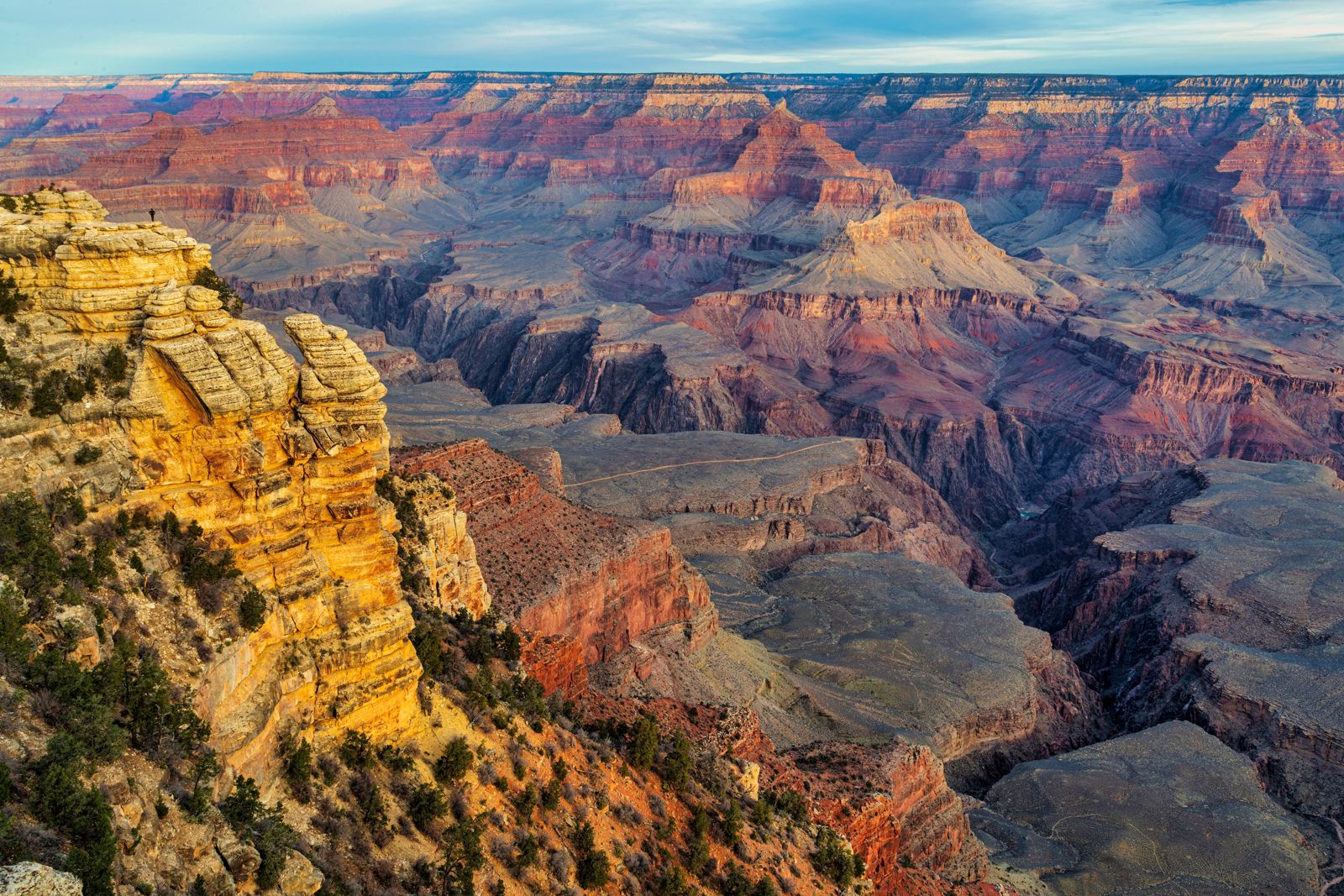
There is no single Grand Canyon weather report, because the canyon holds several climates at once. The South Rim, where nine in ten visitors go, sits at about 7,000 feet and has warm summer days, cold nights and snowy winters. The North Rim, around 8,000 feet, is cooler and wetter still, and is only open for part of the year. A mile below both, at Phantom Ranch on the Colorado River, the air is desert air: summer highs there average well over 100°F, and the park has recorded 120°F.
The National Park Service sums it up in one line: the canyon itself makes the weather. Below, season by season, is what that means on the rims and in the inner canyon, using the park’s own figures, plus the storms, snow and closures that matter more than the averages.
Three climates in one canyon
The park’s weather stations make the point. The coolest and wettest station in the region, on the North Rim at 8,297 feet (2,529 m), is less than eight miles from one of the hottest and driest, Phantom Ranch at 2,460 feet (750 m). Across the whole area, elevations run from around 2000 feet to over 8000 feet (760-2440 m).
The rule of thumb the park gives is simple: temperature rises about 5.5°F with every 1,000 feet you lose in elevation. Walk from the South Rim to the river and you descend roughly a mile, which is why the park says summer highs at Phantom Ranch average around 30°F (17°C) warmer than on the rims.
The records show the range:
- Coldest: -22°F on the North Rim, on February 1, 1985.
- Hottest: 120°F at Phantom Ranch, reached on several summer dates.
- Wettest place: the North Rim, with 25.8 inches of moisture a year on average (and 45.03 inches in 1978).
- Driest place: Lees Ferry, with only 6.1 inches a year (and just 2.7 inches in 1955).
Daily swings are large too. Low humidity and clear skies let the sun heat the ground quickly by day and let the heat escape fast at night. In the dry early summer, the park notes, average monthly highs are more than 30 degrees warmer than average lows at all its stations except Pearce Ferry. A shirt-sleeve afternoon on the rim can turn into a jacket evening within a couple of hours.
Month by month: the South Rim and the inner canyon
The park publishes average temperatures for the South Rim, where most visitors spend their time, and for the inner canyon, the zone around Phantom Ranch and the river that hikers, mule riders and rafters reach. Figures are in °F.
| Month | South Rim high | South Rim low | Inner canyon high | Inner canyon low |
|---|---|---|---|---|
| January | 41 | 18 | 56 | 36 |
| February | 45 | 21 | 62 | 42 |
| March | 51 | 25 | 71 | 48 |
| April | 60 | 32 | 82 | 56 |
| May | 70 | 39 | 92 | 63 |
| June | 81 | 47 | 101 | 72 |
| July | 84 | 54 | 106 | 78 |
| August | 82 | 53 | 103 | 75 |
| September | 76 | 47 | 97 | 69 |
| October | 65 | 36 | 84 | 58 |
| November | 52 | 27 | 68 | 46 |
| December | 43 | 20 | 57 | 37 |
Two things stand out. In these monthly averages the gap between rim and river is around 20°F all year, a little less than the 30°F the park quotes on its hiking pages for summer highs at Phantom Ranch. And on the rim the nights are cold in every season: the average low stays below freezing from November through March, and in July, the warmest month, it is only 54°F (12°C). In Celsius, the South Rim’s average July high is 29°C and the inner canyon’s 41°C.
These are averages. The park warns that daytime summer temperatures in the inner canyon can exceed 110°F (43°C), and on its weather dangers page that highs can potentially top 120F.
Spring: March to May
Spring is the most changeable season. By mid-April, the park says, winter weather usually begins to break, but snow is not uncommon in May, and snowfall has been reported as late as the middle of June.
What to expect:
- On the rim: average highs climb from the 50s and 60s (10-21°C) in April through the 70s to 80s (21-32°C) by June. Nights fall below freezing in April and May.
- Along the river: highs climb from the 80s (27-32°C) in April to near 105 (41°C) by June, with lows rising from the 50s (10-15°C) to the 70s (21-26°C).
- Wind: spring is typically breezy to windy, with gusts occasionally over 40 mph (18 m/s).
- Dryness: late spring and early summer are the driest times of the year, with relative humidity often falling below 10% during the day.
The dry air has a catch. Because so little moisture holds the warmth overnight, frosts can come late; the park has recorded sub-freezing temperatures as late as July on the North Rim. For a rim visit, April and May often bring clear, mild days, but pack for winter mornings.
Summer: June to early September
Summer is the busiest season, and on the rim it is pleasant. The park describes South Rim highs, at 7000 feet (2135 m), as generally in the 80s (27-32°C), with lows in the 40s and 50s (4-15°C). The North Rim, at 8000 feet (2440 m), is cooler, with highs typically in the 70s (21-26°C), and overnight lows can still drop near or below freezing there occasionally.
Below the rim, summer is dangerous. At the river near Phantom Ranch, temperatures typically climb to over 100 degrees, with lows in the 60s and 70s (16-26°C), so the canyon floor barely cools at night. The inner canyon, in the park’s words, is a harsh desert with little shade and summer temperatures over 100°F.
That is why the National Park Service urges caution for all hikers from May through September, and why it advises not hiking at all between 10 am and 4 pm in summer. Our article on hiking the Grand Canyon covers what that means trail by trail.
Summer also brings the crowds. The park expects traffic congestion and parking problems on the South Rim, especially during spring break and the summer months, and strongly recommends reservations for lodging and camping in spring, summer and fall.
The monsoon: thunderstorms, lightning and flash floods
By midsummer, heat over the southwestern deserts draws in moist air, and the late-summer monsoon begins. Moisture usually approaches from the south or southeast. A typical monsoon day, the park explains, begins clear, with clouds building by mid-morning and thunderstorms developing as the ground heats.
Key facts about the storm season:
- When: summer thunderstorms frequently occur during July, August and early September, mainly between 11 a.m. and 6 p.m.
- How strong: torrential rain and frequent lightning are normal; some storms reach severe levels, with large hail, damaging winds and occasionally even a tornado.
- Dry storms: some rain evaporates before reaching the ground, trailing from the clouds as veil-like virga, and lightning from these dry thunderstorms can ignite forest fires.
- When it ends: the summer rains typically diminish in mid-September.
Lightning
Lightning has killed and injured visitors to the park. The canyon gives no protection: the park warns that lightning can strike 10 miles across the canyon, so being below the rim does not put you in a low spot. If a storm builds, move away from the rim, from cliff edges, lone trees, poles and metal railings, and do not shelter in caves or alcoves. The rim viewpoints are among the most exposed places in the park, so plan sunset viewing around the forecast in July and August.
Flash floods
Thunderstorms also cause flash floods in the side canyons, and these can arrive at the canyon bottom without warning. The park records that hikers have been killed in flash floods generated by thunderstorms as far as 25 miles away. It does not have to be raining where you stand.
The danger is not theoretical. After significant flash flooding in Bright Angel Canyon on August 29, the park closed the whole North Kaibab Trail and all of Phantom Ranch, and as of October 21, 2026 it gave no estimated reopening date. Flash floods can occur at any time of year, but the park asks for special caution from July to mid-September.
Fall: September to November
Fall is many visitors’ favorite season, and the numbers explain why. On the rim, average highs fall from the 60s (16-21°C) in September through the 50s (10-15°C) by November. Along the river they fall from the 90s (32-37°C) to near 70 (21°C), and lows stay in the 50s and 60s (10-21°C) there, while nights on the rim drop below freezing.
The monsoon fades in mid-September, and the park describes a drier fall as the norm, with fewer days of rain. It also warns that this is a transition season: late thunderstorms and early winter snowstorms have both been known to arrive, bringing sudden changes.
For hikers, October is the month when inner-canyon highs drop back into the 80s, with an average of 84°F (29°C) at the river. For rim visitors, crowds thin after the summer, though the park still recommends reservations through the fall.
Winter: snow on the rims
Winter weather typically begins by November and is well entrenched by December and January. The park’s description of the South Rim in winter is blunt: conditions can be extreme, so be prepared for snow, icy roads and trails, and possible road closures.
What winter looks like:
- Rim temperatures: lows generally in the teens, but afternoon highs still average in the 40s (4-9°C) thanks to strong sunshine.
- Cold snaps: between storms, with fresh snow on the ground and light winds, sub-zero temperatures are likely on the rim.
- Inner canyon: cold air gets trapped in the gorge, so highs at the river are only in the 40s and 50s (4-15°C), with lows in the 30s and 40s.
- Fog: in winter and early spring fog occasionally forms over the snow, but usually breaks up quickly by morning.
Winter has real advantages. The park names November through February as the least crowded time to visit, and Hermit Road, closed to private vehicles from March 1 through November 30, opens to cars in December, January and February unless it is closed by snow. The South Rim stays open all year, 24 hours a day, but during winter storms some roads may close temporarily while snow is cleared.
On the trails, the upper parts of the Bright Angel and South Kaibab trails may be extremely icy in winter and early spring.
Snow and rain in numbers
Snow is a rim phenomenon. Winter precipitation usually falls as snow on the rims but melts to rain before reaching the canyon floor.
- North Rim: the heaviest snowfall, averaging 142 inches a year, with a record 272.8 inches (almost 23 feet) in 1978.
- South Rim: an average of 58 inches of snow a year.
- Phantom Ranch: less than 1 inch.
The park’s broader figure for the rims is an average of 50 to over 100 inches (1.3-2.5 m) of snow a year, and snow remains possible at higher elevations through April. Moisture for these winter storms generally comes from the North Pacific; the summer moisture, by contrast, arrives from the south with the monsoon.
The North Rim’s short season
The North Rim is a different trip. Its season runs from mid-May to mid-October; in 2026 the park listed it as open from May 15 through October 15, 2026.
The 2026 season was also unusual. After the Dragon Bravo Fire, the park focused the North Rim season mainly on day use and limited backcountry access, closed popular rim trails such as Bright Angel Point and Widforss, and warned that no potable water was available on the North Rim. Cape Royal Road and Point Imperial Road close temporarily from sunset October 15 through sunrise November 3, 2026, for road repair. Check the park’s North Rim status page before planning a visit for next season.
How weather changes a visit
Weather shapes more than what you wear:
- Shuttle buses: the park’s free shuttles may be suspended in bad weather, and Hermit Road service is suspended during summer thunderstorms.
- Hiking: the park does not recommend hiking from the rim to the river and back in one day, and summer heat is the main reason. More than 300 people are rescued from the canyon each year.
- Flights: helicopter and airplane tours over the canyon are weather-dependent like everything else here; our helicopter tours guide compares the options.
- Driving in: distances are long and services sparse. The park advises carrying several gallons of water in the car in summer. For routes from Las Vegas and Flagstaff, see our guide to getting to the Grand Canyon.
What to pack, season by season
The single most useful habit is layering, because a day on the rim can span 30 degrees or more.
- Spring: warm jacket, hat and gloves for mornings; sun protection for afternoons; lip balm for the dry air.
- Summer: sun hat, sunscreen, light long sleeves, a refillable water bottle, and a rain shell for afternoon storms.
- Fall: a fleece and windproof layer; warmer gear for evenings from October.
- Winter: insulated jacket, warm hat, gloves and boots with good grip; traction devices if you plan to walk the upper trails.
Whatever the season, the park’s advice is to check the forecast before you go and again on the day, and to be willing to change your plans. On its weather dangers page it says postponing a hike for a day or two is a wise decision when weather threatens.
When is the best time to visit?
It depends on what you want to do:
- Rim sightseeing with comfortable weather: April to early June, and mid-September to October, both outside the monsoon and the worst heat.
- Fewest people: November through February, if you are ready for snow and cold.
- Hiking below the rim: spring and fall, when inner-canyon highs are in the 70s and 80s rather than over 100°F.
- The North Rim: only in its season, roughly mid-May to mid-October.
- Storm watching and dramatic skies: July and August, with caution about lightning.
For entrance fees and passes in any season, see our guide to Grand Canyon tickets and prices, and for what to do once you arrive, our list of things to do at the Grand Canyon.
Frequently asked questions
What is the weather like at the Grand Canyon?
It depends on where you stand. The South Rim, at about 7,000 feet, has summer highs generally in the 80s and winter highs in the 40s. The North Rim is cooler and snowier. The inner canyon is desert: July highs average 106°F at the river.
What is the hottest month at the Grand Canyon?
July. Average inner-canyon highs peak at 106°F (41°C) in July, and Phantom Ranch has recorded 120°F. On the rim, July is warm but rarely extreme.
Does it snow at the Grand Canyon?
Yes, on the rims. The South Rim averages 58 inches of snow a year and the North Rim 142 inches. Phantom Ranch, near the river, gets less than 1 inch, because snow usually melts to rain before reaching the canyon floor.
When is monsoon season at the Grand Canyon?
The park describes thunderstorms frequently occurring in July, August and early September, mainly between 11 a.m. and 6 p.m., with lightning and flash floods. The rains typically diminish in mid-September.
Is the Grand Canyon open in winter?
The South Rim is open all year, 24 hours a day, though roads may close temporarily while snow is cleared. The North Rim closes for the winter; in 2026 its season ran from May 15 through October 15.